 Store Locator

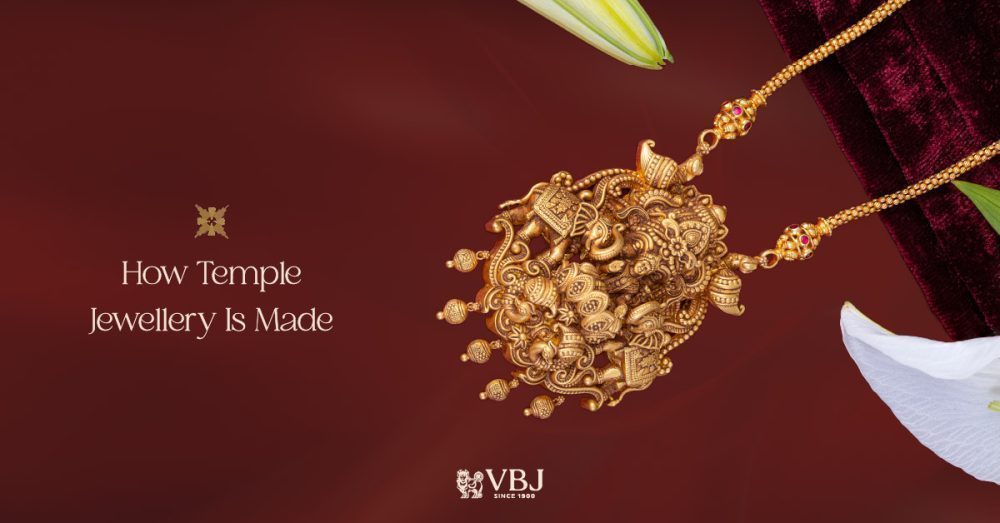
Temple jewellery is more than an ornament, It’s a masterpiece of devotion, artistry, and heritage. Recognised for its intricate carvings, divine motifs, and regal grandeur, temple jewellery has adorned deities, royalty, classical dancers, and brides for centuries.
What makes these pieces truly extraordinary isn’t just their appearance, but the painstaking craftsmanship behind every necklace, haram, jhumka, and vanki. Unlike mass-produced jewellery, handmade temple jewellery involves multiple stages of skilled craftsmanship, often taking weeks, or even months, to complete.
In this guide, we take you behind the scenes of the temple jewellery making process, exploring the techniques, artisanship, and traditions that continue to keep this iconic South Indian art form alive.
The History Behind Temple Jewellery Craftsmanship
The origins of temple jewellery can be traced back to the magnificent temples of South India during the Chola and Vijayanagara dynasties. Skilled goldsmiths were commissioned to create elaborate ornaments for temple idols, inspired by divine symbolism and architectural beauty.
Over time, these intricate designs found their way into royal courts before becoming an integral part of South Indian bridal traditions.
Even today, many of the motifs used in handmade temple jewellery remain unchanged, preserving centuries of artistic heritage.
How Temple Jewellery Is Made?
The beauty of temple jewellery lies in its ability to bridge the sacred and the personal. Every motif, every engraving, and every gemstone is thoughtfully chosen to represent prosperity, protection, devotion, and abundance.
Unlike modern jewellery that often follows seasonal trends, temple jewellery continues to celebrate timeless craftsmanship.
Step 1: Designing the Motif
Every temple jewellery piece begins with an idea.
Master designers first sketch the jewellery, carefully considering its proportions, balance, and storytelling. Rather than creating purely decorative patterns, temple jewellery draws inspiration from sacred imagery and traditional South Indian symbolism.
Popular motifs include:
- Goddess Lakshmi
- Lord Ganesha
- Peacocks
- Elephants
- Lotus flowers
- Yalis
- Floral vines
- Traditional temple architecture
Each design must maintain harmony while allowing enough space for gemstone placement and intricate detailing.
This planning stage is critical because the complexity of temple jewellery leaves little room for error later in the process.
Step 2: Casting and Base Preparation
Once the design is finalised, artisans begin creating the base structure.
Gold is carefully melted and cast into the required forms using traditional casting techniques. Depending on the design, individual components may be cast separately before being assembled into a complete piece.
At this stage, the jewellery appears simple and unfinished.
The focus is on ensuring:
- Structural strength
- Accurate proportions
- Even thickness
- Smooth framework for engraving
Temple jewellery often contains numerous interconnected components, allowing necklaces and earrings to move naturally while retaining their grandeur.
The casting process lays the foundation for every detail that follows.
Step 3: Engraving and Intricate Detailing
This is where temple jewellery truly comes to life.
Highly skilled artisans spend hours, sometimes days, hand engraving every surface to create depth and dimension.
Using specialised tools, they carve:
- Facial expressions of deities
- Ornamental borders
- Floral patterns
- Feathers on peacocks
- Intricate textures
- Temple-inspired architectural elements
Unlike machine engraving, handcrafted detailing gives every piece its own character.
No two handmade temple jewellery pieces are ever completely identical, making each creation uniquely valuable.
This stage demands years of experience, patience, and artistic precision.
Step 4: Setting Kemp Stones and Gemstones
One of the defining characteristics of traditional South Indian temple jewellery is the use of vibrant coloured stones.
Kemp Stone Setting
Kemp stones, typically rich shades of ruby red and emerald green, are synonymous with temple jewellery.
Each stone is individually selected and hand-set into precisely carved spaces.
This delicate process requires exceptional accuracy to ensure:
- Symmetry
- Secure placement
- Uniform spacing
- Balanced colour distribution
Beyond kemp stones, artisans may also incorporate:
- Emeralds
- Rubies
- Pearls
- Uncut diamonds
- Other precious gemstones
The gemstone setting enhances the intricate carvings while adding vibrancy and richness to the overall design.
Because every stone is positioned manually, this remains one of the most time-intensive stages of temple jewellery craftsmanship.
Step 5: Finishing and Polishing
After all components have been assembled and gemstones secured, the jewellery undergoes meticulous finishing.
Artisans inspect every detail to ensure:
- Smooth edges
- Perfect alignment
- Secure gemstone settings
- Uniform polish
- Comfortable wearability
The jewellery is then polished to bring out the richness of the gold while preserving the depth of the handcrafted carvings.
Quality checks are conducted throughout the finishing process, ensuring every piece meets the highest standards before reaching its wearer.
Only after passing these inspections is the jewellery considered complete.
The Skilled Artisans Behind Temple Jewellery
Temple jewellery is the result of collaborative craftsmanship.
Several specialised artisans contribute to each piece, including:
Designers
They conceptualise motifs, proportions, and structural layouts while preserving traditional aesthetics.
Goldsmiths
They cast, shape, solder, and assemble the jewellery with exceptional precision.
Engravers
Their expertise transforms plain gold surfaces into intricate works of art filled with symbolic detail.
Stone Setters
They carefully position every kemp stone and gemstone by hand, ensuring durability and visual balance.
Polishers
The final stage requires artisans who understand how to enhance brilliance without compromising the handcrafted details.
Together, these craftsmen preserve techniques that have been passed down through generations.
Why Handmade Temple Jewellery Takes Time
In an age of automation, handmade temple jewellery remains remarkably labour-intensive.
Each stage requires human skill, patience, and artistic judgement.
Unlike machine-made jewellery, handcrafted temple jewellery offers:
- Exceptional detailing
- Superior craftsmanship
- Individual character
- Strong heirloom value
- Long-lasting durability
- Cultural authenticity
The time invested in creating every piece ensures it becomes more than jewellery, it becomes a family treasure.
Many temple jewellery creations are passed from one generation to the next, carrying stories, blessings, and memories along with them.
How VBJ Preserves This Craftsmanship Today
For over a century, Vummidi Bangaru Jewellers has celebrated South India’s rich jewellery traditions while embracing the highest standards of craftsmanship.
Temple jewellery remains one of the brand’s most treasured offerings, created with meticulous attention to detail by skilled artisans who continue to honour traditional techniques.
By preserving handcrafted methods, incorporating authentic South Indian motifs, and maintaining exceptional quality standards, VBJ ensures that every temple jewellery creation reflects both heritage and enduring elegance.
Each piece is designed not only for today’s celebrations but also to become an heirloom for generations to come.
Conclusion
Temple jewellery is a remarkable expression of South India’s artistic and cultural heritage. Every stage, from designing sacred motifs and casting gold to engraving intricate details and setting vibrant kemp stones, reflects extraordinary craftsmanship that has been preserved for centuries.
Its enduring appeal lies not only in its beauty but in the human skill, patience, and tradition woven into every creation. Whether worn by a bride, treasured as an heirloom, or admired as a work of art, handmade temple jewellery continues to celebrate a legacy of devotion and excellence.
At Vummidi Bangaru Jewellers (VBJ), this legacy lives on through masterfully crafted temple jewellery that honours tradition while creating timeless pieces for generations to cherish.
Frequently Asked Questions
How is temple jewellery made?
Temple jewellery is made through a detailed handcrafted process involving design sketching, gold casting, engraving, gemstone setting, polishing, and multiple quality checks.
What makes temple jewellery unique?
Its intricate deity motifs, handcrafted detailing, kemp stone setting, and strong cultural symbolism distinguish temple jewellery from other traditional jewellery styles.
What are kemp stones?
Kemp stones are traditional red and green stones widely used in South Indian temple jewellery to enhance its vibrant appearance.
Is temple jewellery handmade?
Yes. Authentic temple jewellery is largely handcrafted by skilled artisans using traditional techniques passed down over generations.
Why is handmade temple jewellery expensive?
The intricate craftsmanship, precious materials, manual labour, and time required to create each piece contribute to its value.


0 Comments